
What to eat in Hangzhou: Dongpo pork, Longjing shrimp, vinegar fish and noodles, with practical ordering advice for two to six travelers and dietary checks.
Use this guide as one planning layer, then match the route with travel dates, arrival city, hotel class, group size, and daily pace.
A first meal in Hangzhou does not need to be a tasting marathon. For two people, one signature dish, vegetables and rice can be a better introduction than a table crowded with every famous name. For a larger party, sharing lets you compare richer dishes with something lighter. This guide helps you read a menu and put together a meal, rather than sending you across the city to collect restaurant names.
Hangzhou's local cooking is often called Hangbang cai, part of Zhejiang cuisine. Tea-scented shrimp, braised pork and vinegar-dressed fish are familiar signatures. The flavors are not all alike: choosing a dish because it is famous is less useful than knowing whether you enjoy fatty meat, delicate seafood or a tangy sauce.
Five dishes to recognize on a menu
Dongpo pork: choose it for richness
Dongpo rou (东坡肉) is braised pork belly, with both fat and lean meat. It is not a lean pork fillet. Think of it as a rich centerpiece to share with plain rice and vegetables, not something everyone needs a large portion of. Ask whether the menu price is per piece or per serving; photographs do not tell you how much will arrive.
Longjing shrimp: choose it for a gentler contrast
Longjing xiaren (龙井虾仁) pairs peeled shrimp with Longjing tea. Expect subtle tea fragrance rather than a strong tea sauce. It makes a useful contrast to braised pork, but a pale-looking dish is not automatically suitable for someone with allergies. Ask the kitchen about coatings, seasoning and cooking ingredients rather than judging from a picture.
West Lake vinegar fish: choose it if you like tangy whole fish
Xihu cuyu (西湖醋鱼) is associated with a sweet-sour vinegar sauce. It is usually a whole-fish dish, so plan for bones and sharing. Ask about fish size, total price and preparation before ordering, especially if a menu uses weight-based pricing. The name does not mean the fish on your plate was caught in West Lake.
Beggar's chicken: check before making it your main plan
Jiaohua ji (叫花鸡) is a wrapped, slowly cooked chicken preparation. Traditional versions use lotus leaves and clay, but modern kitchens may use different cooking containers. Check availability, advance-order requirements and portion size. Stuffing can include pork, so ordering chicken is not enough to establish that a meal is pork-free. For two diners, ask whether a smaller portion is possible before adding several other main dishes.
Pian'er chuan: a noodle-shop alternative
Pian'er chuan (片儿川) is a local soup-noodle choice, useful when you want an individual bowl rather than a shared restaurant meal. Check the actual toppings and broth on the menu. Do not assume a bowl with plenty of vegetables is vegetarian, or that removing visible meat changes the stock.
Hangzhou's official introduction to local dishes describes these culinary traditions. Our ordering suggestions below are practical planning advice, not fixed restaurant menus.
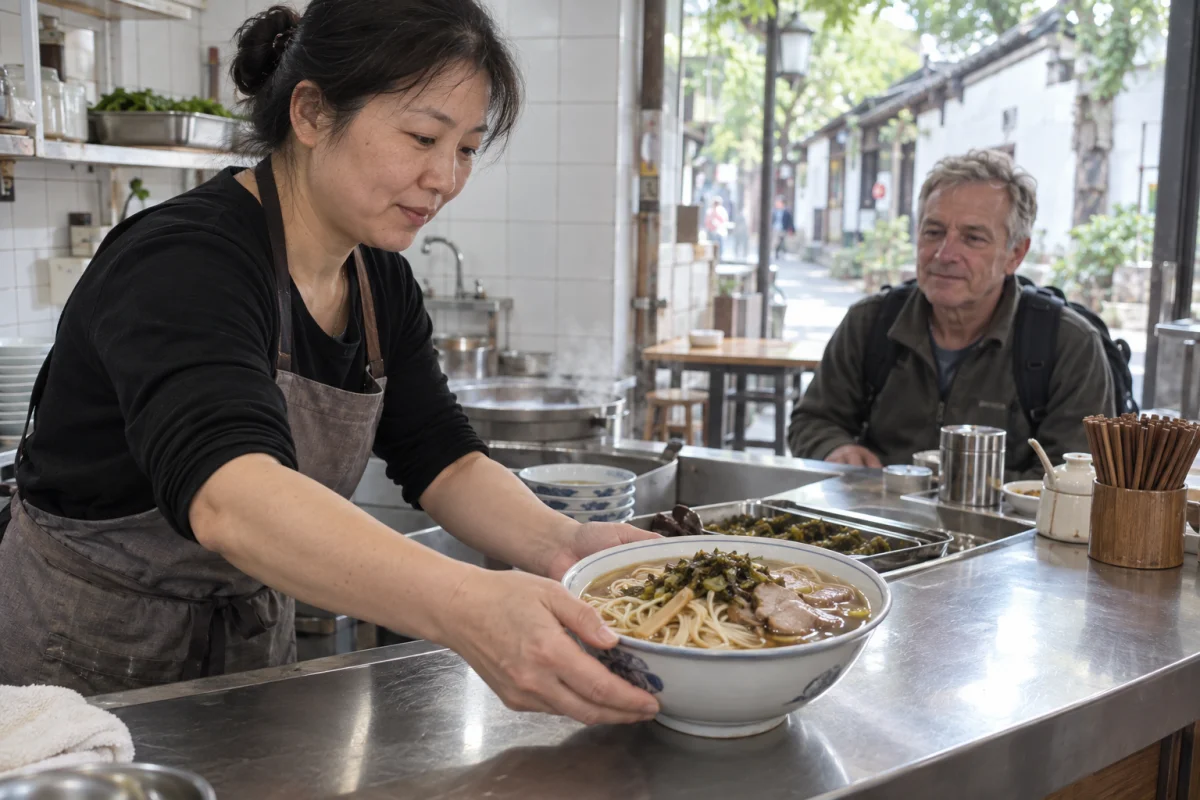
How to order for two to six travelers
For two: start with one main dish you both want, one vegetable dish and rice. Add a second main if the portions and your appetite justify it. If you choose a whole chicken or fish, ask how many it serves before ordering more. There is no need to order both just because both are local specialties.
For three or four: a useful starting point is two contrasting mains, one or two vegetables, and rice. For example, choose a braised dish and a lighter seafood dish, if everyone eats those ingredients. Add soup only if you want it; it should not be an automatic extra alongside large portions.
For five or six: let the server explain serving sizes before choosing three or four shared mains plus vegetables and staples. Check that each diner has enough food they can actually eat. One vegetarian plate for several people with different dietary needs is not a balanced solution.
These are starting points, not a per-person formula. Ask whether rice is ordered separately and request serving utensils for shared plates. If you are still hungry, adding a dish is usually more sensible than over-ordering from photographs.
Build a food stop into a Hangzhou visit
Only in town for the day? Choose a sit-down local lunch if food is a priority. Pick the restaurant around the actual sightseeing route, then leave a realistic meal window before your next transfer. If time is limited, a noodle lunch can avoid turning a meal into another cross-city journey. The Shanghai-to-Hangzhou day-trip guide covers how the lake, temple and tea areas fit together.
Staying overnight? Use one meal for noodles and another for shared dishes. This gives you variety without ordering the same rich food twice. Coordinate lunch with your chosen West Lake walk or boat visit, but do not assume every lakeside restaurant serves the same local dishes.
Interested in Longjing tea? Treat tea tasting and a meal as separate decisions. Ask what a tasting costs and whether any purchase is expected. A dish made with tea does not require a shopping stop, and ordering Longjing shrimp does not establish the grade or origin of tea served alongside it.
Dietary needs: ask about the recipe, not only the dish name
Explain specific ingredients you cannot eat before ordering. Ask about stock, sauces, cooking oil, coatings and shared preparation, not just visible toppings. Tofu and vegetables are not proof that a dish is vegetarian; a restaurant needs to confirm its own recipe. Similarly, a mild flavor does not mean a meal is free from allergens.
For a strict dietary requirement, request confirmation before selecting a restaurant. Do not rely on a generic translation such as "I eat lightly" or "no meat" when the real requirement concerns particular ingredients or cross-contact. Our China meal and dietary-needs guide explains what to communicate when planning a private trip.
Questions worth asking before you sit down
- Is the dish available today, and does it need advance ordering?
- Is the price per piece, per plate or by weight, and what is the total?
- How many people does this portion serve?
- Can the kitchen meet our specific ingredient restrictions?
- How long will the main dish take, given our next transfer?
Menu translations, portions and preparation vary by restaurant. This is a dish-selection guide, not a guarantee of availability or a restaurant booking. For a private Hangzhou day tour from Shanghai, tell us your group size, food priorities, dietary requirements and whether you prefer a quick lunch or a longer local meal. The restaurant and meal arrangements can then be confirmed with the rest of your day; meals are included only where your agreed quotation says so.
Editorial review: September 15, 2026. Images are AI-generated travel illustrations; dishes and settings are illustrative rather than evidence of a particular venue.
Continue Planning Shanghai
Shanghai tours and services
Move from planning advice into a private route, transfer, guide, or day-trip request.
Shanghai planning guides
Use these guides to decide hotel area, first day, evening pace, food and weather backup.
Plan a Trip from This Guide
Share your travel dates, group size, and the ideas you liked in this guide. We can turn them into a private China itinerary.