
A practical route-choice guide for East China private tours, comparing 6-day, 7-day and 9-day plans from Shanghai through Suzhou, Hangzhou, Wuxi and Jiangnan water towns.
Shanghai planning works best when hotel area, transfer timing, meal stops, guide hours, and walking level are considered together.
East China looks simple on a map. Shanghai, Suzhou, Hangzhou, Wuxi and the water towns sit close enough that many travelers assume they can be joined without much tradeoff. In practice, the right route length changes the trip completely. A 6-day plan can feel efficient and focused. A 7-day plan gives the classic Shanghai-Suzhou-Hangzhou route a more humane pace. A 9-day plan becomes a fuller Jiangnan itinerary with Wuxi, Lake Tai scenery, and more room for slower water-town time.
This guide compares the main choices so you can decide whether to keep the route compact or give East China more days. It supports the private routes now available on Go2ChinaTours, including the Shanghai, Suzhou and Hangzhou 6-Day Private Tour, the Shanghai, Suzhou and Hangzhou 7-Day Private Tour, and the fuller Shanghai, Suzhou, Hangzhou, Wuxi and Water Town 9-Day Private Tour.
Quick answer
Choose 6 days if you want a compact first East China route and can accept fuller sightseeing days. Choose 7 days if you want the classic Shanghai, Suzhou, Hangzhou and water town rhythm without rushing the Shanghai portion. Choose 9 days if Wuxi, Lake Tai, Nianhua Bay, Lingshan Grand Buddha, and a broader Jiangnan loop matter to you.
If the group includes senior travelers, children, long-haul arrival fatigue, or several hotel changes, the extra day is often more valuable than it looks on paper. The difference is not only adding sights. It is reducing the pressure on transfers, meals, check-in time, and walking.
How the routes differ
| Route length | Best for | Main strength | Main tradeoff |
|---|---|---|---|
| 6 days | Travelers who want Shanghai, a water town, Suzhou and Hangzhou in a compact plan. | Efficient classic coverage with a clear Shanghai start and finish. | Less buffer for jet lag, weather, hotel changes and slower meals. |
| 7 days | First-time visitors who want the classic route at a more comfortable pace. | More breathing room in Shanghai before moving into Jiangnan. | Still focused on the classic triangle; Wuxi usually stays out. |
| 9 days | Travelers who want a fuller East China loop with Wuxi and Lake Tai context. | More depth, less rush, and a broader Jiangnan story. | More hotel nights, more routing choices and a higher total trip budget. |
Choose 6 days when the route needs to stay efficient
The 6-day version works when East China is one section of a larger China trip. It can cover Shanghai highlights, a Jiangnan water town, Suzhou gardens and Hangzhou West Lake without expanding into a long regional loop. This is useful when travelers are combining East China with Beijing, Xi'an, Guilin, Chengdu or Zhangjiajie.
The route still needs discipline. Do not try to turn every city into a full museum, garden, food and shopping checklist. A realistic 6-day private route should protect the strongest sights: Shanghai skyline and old city, Zhouzhuang or another water town, one or two Suzhou garden/history anchors, Hangzhou West Lake, Lingyin Temple or tea village time, and clean transfer planning.
For travelers who know they want Hangzhou but are not sure what to prioritize there, read the Shanghai to Hangzhou planning guide. Even on a multi-day route, the same decision applies: lake, temple and tea village time must be balanced rather than stacked carelessly.
Choose 7 days when comfort matters more than one more city
The 7-day route is often the safest recommendation for first-time visitors who want the classic Shanghai, Suzhou and Hangzhou experience. It does not try to add Wuxi. Instead, it gives Shanghai more room and makes the Jiangnan section less rushed.
This matters because Shanghai arrival days are often not productive sightseeing days. Long-haul flights, airport transfer, hotel check-in, jet lag, phone setup and first meals all take energy. If the route pushes too hard on the first full day, the whole trip can feel behind schedule. A 7-day plan can separate skyline, old city and neighborhood time more naturally before the group moves toward water towns and gardens.
The 7-day plan is especially useful for families, senior travelers, photography-focused guests and travelers who dislike changing hotels too quickly. It also gives the guide more room to adjust around weather, traffic, attraction opening hours and meal timing.
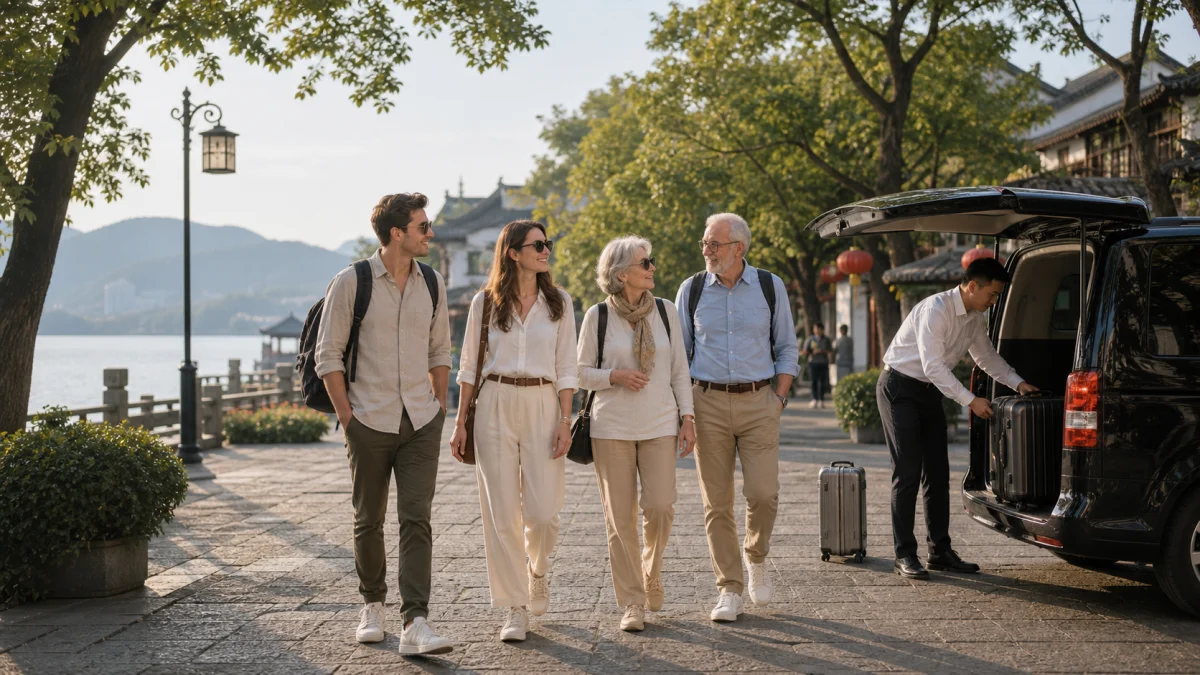
Choose 9 days when Wuxi and a fuller Jiangnan loop are worth it
The 9-day route is a different kind of trip. It is not simply the 7-day route with two random extra nights. It adds Wuxi and gives the region a broader shape: Shanghai city, Zhouzhuang water town, Suzhou gardens, Wuxi cultural and Lake Tai scenery, then Hangzhou lake, temple and tea village before returning to Shanghai.
Wuxi is the main reason to upgrade. Lingshan Grand Buddha and Nianhua Bay give the route a different cultural rhythm from Suzhou and Hangzhou. Three Kingdoms City, Water Margin City and Turtle Head Isle can add Lake Tai and scenic variety. These stops make the itinerary feel more like an East China loop rather than only a Shanghai-Suzhou-Hangzhou triangle.
The 9-day route is also better for travelers who want more comfortable hotel timing. Instead of treating intercity movement as dead time, the route can use transfers as part of the day. That is valuable when the group has luggage, children, older travelers or specific meal needs.
What if you only want Shanghai and one water town?
Not every traveler needs the full Jiangnan loop. If the priority is Shanghai city sightseeing with one atmospheric water town extension, a shorter route may be better. The Shanghai and Wuzhen 5-Day Private Tour gives Wuzhen more emphasis, while the Shanghai, Suzhou and Zhouzhuang 6-Day Private Tour is better when Suzhou gardens are also important.
If the group wants Shanghai only, with no water town or intercity travel, the Shanghai 4-Day Private Tour is cleaner. It keeps the Bund, Pudong skyline, Yu Garden area, old city, Former French Concession or Xintiandi, and departure transfer support in a compact city plan.
For a broader comparison of water town choices, use the Shanghai water town day trips guide. The same logic applies to multi-day tours: nearby water towns are easier, farther water towns can feel deeper, and the right choice depends on transfer tolerance.
Private car or high-speed rail?
East China has strong high-speed rail connections, but private tour planning is not only about the fastest point-to-point movement. Rail can work well when stations are convenient, luggage is light, and the group is comfortable moving through a busy station. Private vehicle routing is often easier when the route includes water towns, garden stops, hotel-to-hotel transfers, seniors, children, or several pieces of luggage.
For Shanghai-based routes, airport and station timing should be planned early. Pudong Airport, Hongqiao Airport and Hongqiao Railway Station do not serve the same purpose. The Shanghai airport and train station transfer guide helps avoid building a route that looks efficient on paper but feels awkward on arrival or departure day.
How to decide before requesting a quote
- Start with arrival energy: If your first Shanghai day follows a long flight, avoid an overloaded schedule.
- Choose the water town role: Quick atmosphere, deeper overnight feeling, or a bridge into Suzhou?
- Decide whether Wuxi matters: If Lingshan, Nianhua Bay and Lake Tai are appealing, consider 9 days.
- Be honest about walking: Gardens, old towns and lakeside routes are enjoyable only if the pace fits the group.
- Protect transfer buffers: Hotel checkout, luggage, station time, traffic and meals all need room.
Bottom line
For most first-time visitors, 7 days is the most balanced classic East China route. Six days is possible when the trip needs to stay compact. Nine days is the better choice when you want Wuxi, Lake Tai, and a fuller Jiangnan loop with less pressure. The right route is not the one with the longest attraction list. It is the one that gives your group the best balance of sights, transfers, meals, hotel rhythm and walking comfort.
Continue Planning Shanghai
Shanghai tours and services
Move from planning advice into a private route, transfer, guide, or day-trip request.

Shanghai planning guides
Use these guides to decide hotel area, first day, evening pace, food and weather backup.
Plan a Trip from This Guide
Share your travel dates, group size, and the ideas you liked in this guide. We can turn them into a private China itinerary.