
A practical guide to China high-speed rail days for international visitors, covering passports, e-tickets, station arrival, security, luggage, boarding, transfers, and private-tour pacing.
Use this guide as one planning layer, then match the route with travel dates, arrival city, hotel class, group size, and daily pace.
China high-speed rail is comfortable once the travel day is set up properly. The part that surprises first-time visitors is usually not the train ride itself. It is the station process: which document to carry, when to arrive, where to pass security, how to read boarding information, what to do with luggage, and how much buffer to keep before the next hotel transfer.
This guide focuses on the practical station and boarding day. For the wider decision between rail and air, use the China high-speed rail vs domestic flights guide. For arrival-day transfers, compare it with the China airport arrival and private transfer tips.
Quick answer: keep the rail day simple
A good high-speed rail day has five simple rules: carry the passport used for the ticket, keep luggage manageable, arrive early enough for security and walking, confirm the correct station, and treat the arrival transfer as part of the itinerary. The train may be fast, but the whole travel day includes hotel checkout, road transfer, security, waiting, boarding, luggage space, arrival walking, and the drive to the next hotel.
For private tours, send the train number, departure station, arrival station, departure time, passenger names, luggage count, and hotel addresses to the planner or guide before the trip. This keeps the driver, guide, and vehicle size aligned with the real travel day.
Passports, real-name tickets and e-tickets
China rail uses real-name ticketing. The official 12306 English FAQ says foreign passengers can use valid passports for real-name tickets, and that passengers should keep the e-ticket information and the valid ID document used for purchase when checking in and out of the station and boarding the train. In practical terms, international visitors should carry the original passport used for the booking, not only a photo or photocopy.
If a guide or travel company books tickets for you, confirm the spelling of each name, passport number, train number, station names, date, and seat class before travel. If anything changes, solve it before reaching the station. Station counters can help with some issues, but queues and language barriers can reduce your buffer.
Do not mix up stations
Many Chinese cities have more than one rail station. The word "North," "South," "East," or "West" can completely change the transfer plan. Beijing, Shanghai, Xi'an, Chengdu, Guilin, Kunming, Hangzhou, Suzhou, and many other cities may have multiple stations used by different services.
Before departure, save the station name in English and Chinese if available, the train number, and the hotel pickup time. A private driver should know the exact station and departure hall, but the traveler should also check the itinerary. A wrong station can turn a comfortable rail day into a missed train.
When to arrive at the station
There is no single perfect arrival time for every station. Large hubs, public holidays, early morning trains, family groups, senior travelers, and first-time visitors all need more buffer. Official 12306 guidance notes that queues may appear at ticket windows, security checks, ID verification counters, ticket gates, and baggage service counters, so travelers should reserve enough time.
For most private-tour rail days, the better plan is to arrive early, clear security calmly, and wait near the boarding area. Cutting the timing tight is rarely worth it, especially when the group has luggage or children.
Security and station entry
Expect a security process before entering the station or boarding area. Bags normally go through screening, and passengers pass through a security gate. Keep passport and ticket information easy to reach, and avoid packing batteries, liquids, tools, sprays, or sharp items in a way that slows the check. Prohibited and restricted items can change, so check 12306 or station notices if you carry anything unusual.
The security area is also where overpacking becomes visible. If each traveler has one suitcase, one day bag, and one loose shopping bag, the group will move much slower through scanners, escalators, and queues.
Luggage: what works best on high-speed rail
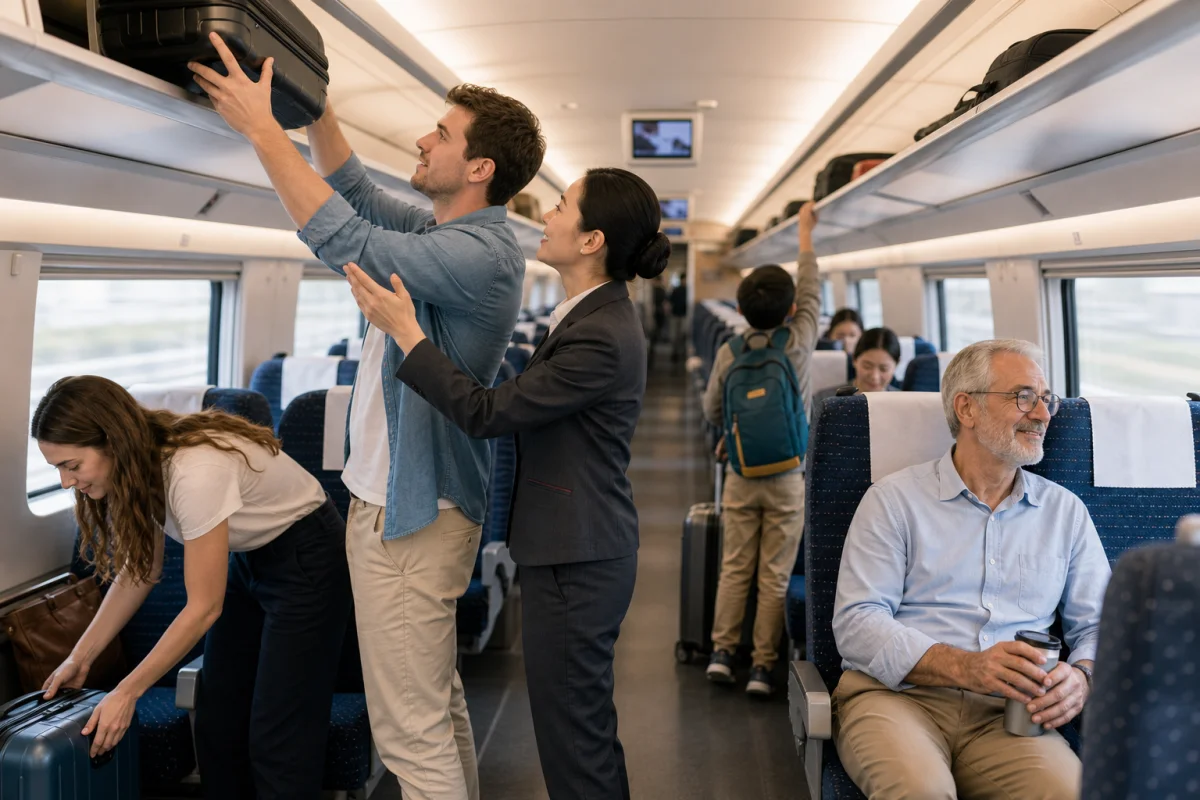
China high-speed trains are not airline-style checked-bag days for most visitors. You carry luggage through the station, security, ticket gates, platform, train door, aisle, and carriage storage areas. The official 12306 English FAQ lists free carry-on limits, including a 20 kg allowance for most passengers and a maximum total dimension of 130 cm per item for EMU trains. Rules and enforcement can change, so use these as planning limits and check current 12306 or station notices before carrying oversized items.
The practical recommendation is simpler: bring bags that one adult can lift or roll without help. Compact suitcases are easier to place near carriage luggage areas or overhead racks. Very large suitcases, multiple loose bags, and heavy shopping items make boarding, transfers, and family movement harder.
Boarding and carriage position
After security, watch for the train number, gate, platform, and boarding time. High-speed rail boarding can be efficient, but the station may be large. Once the gate opens, follow the flow, check the platform direction, and move to the carriage area calmly. If your group includes children or older travelers, keep everyone together before the gate opens rather than trying to regroup on the platform.
On the platform, do not block the door area while reorganizing bags. Put passports and phones away securely, keep one hand free for luggage, and let passengers leave the train before boarding when needed.
Inside the carriage
Find the carriage and seats first, then handle luggage. Smaller bags can usually go overhead if they are light enough to lift safely. Larger suitcases may need carriage luggage space. Keep medicine, passports, wallet, phone, charger, water, snacks, and children's items in a day bag that stays with you.
For senior travelers, avoid asking them to manage heavy overhead luggage. A guide can help coordinate the process, but luggage should still be packed with realistic lifting and aisle movement in mind.
Food, water and onboard comfort
Longer rail days are easier with a simple comfort kit: water, light snacks, tissues, hand sanitizer, charger, power bank, medicine, and a thin layer. Not every train meal or station food option will match your timing or dietary preference. If the route connects with sightseeing immediately after arrival, avoid depending on a late lunch that may not happen on schedule.
Families should pack small snacks and entertainment for children. Senior travelers may prefer an aisle seat, extra time to board, and a lighter schedule after arrival.
Arrival and transfer planning
Arrival is not finished when the train stops. You still need to leave the carriage, collect bags, walk through the station, pass any exit check, find the meeting point, and drive to the hotel or first sight. Large arrival stations can feel similar to airports in walking distance.
For private tours, confirm the exit or meeting point before the day begins. If the driver cannot enter the station area, the guide may meet you inside or at a designated exit. Share luggage count and group pace so the vehicle and pickup timing are realistic.
When high-speed rail is especially good
Rail works very well on many city pairs when the station locations, schedule, luggage, and sightseeing rhythm fit together. It can be especially useful between Beijing, Xi'an, Shanghai, Suzhou, Hangzhou, Chengdu, Chongqing, Guilin, Kunming, Dali, and other rail-connected destinations. But the best choice is always route-specific.
Use city transfer guides when the exact station matters: Beijing airport and train station transfers, Shanghai airport and train station transfers, Xi'an airport and train station transfers, Chengdu airport and train station transfers, and Yunnan airport and train station transfers.
Checklist before a China rail day
- Original passport used for booking is packed and easy to reach.
- Train number, date, departure station, arrival station, and seat details are saved offline.
- Station name is checked carefully, including North, South, East, or West.
- Driver pickup time allows traffic, security, walking, and family pace.
- Luggage is compact enough to roll, lift, and move through aisles.
- Power bank, medicine, water, snacks, and documents stay in a day bag.
- Arrival meeting point and hotel transfer plan are confirmed.
Bottom line
China high-speed rail is usually a strong travel tool, but it rewards practical planning. Keep documents correct, luggage compact, timing generous, and station names precise. When the rail day is planned door to door, the train becomes a comfortable link in the itinerary rather than a stressful travel experiment.
Official check: real-name ticketing, passport acceptance, e-ticket procedures, luggage rules, security checks, and station services can change. Before carrying oversized items or making tight transfers, check the China Railway 12306 English FAQ and current station notices.
More Planning Links for This Guide
Related Tour Ideas
Tour pages that match the same city, topic, or planning intent.



Destination Planning Links
City and destination-topic pages that help readers go deeper.


Related Travel Guides
Article links for the next planning question.



Topic Hubs
Topic pages that collect routes or guides around the same intent.


Plan a Trip from This Guide
Share your travel dates, group size, and the ideas you liked in this guide. We can turn them into a private China itinerary.